

2026’s venture capital market is gearing up to be one for the history books. And depending on what happens over the next few years, at a macroeconomic level, this year could be seen as a critical inflection point in this technological era, before the impact of artificial intelligence begins to become evident and productivity across the entire economy increases. On the other hand, 2026 might also be seen as the pinnacle of exuberance, both for AI and for easy-ish money, and could end up being a case study for generations to come. Now I’m not saying that this current year is a 1929, 1987 or even an 1873 – but it’s not outlandish to think 2026 is so different and unprecedented that it could mark a shift in what comes after.
Why the hyperbole? Well this chart below, which covers the number of venture capital deals and amount of capital deployed in the first two quarters of each year since 2020, should explain some of it:
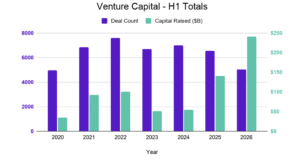
Notice that there is a clear divergence between the purple and teal bars. The declining purple bars indicate a continual decrease in the number of deals coming together in the Venture Capital industry. In fact, the first half of 2026 had roughly the same number of deals close as in the first half of 2020, when there were other… things… happening in the world.
However, what is remarkable about this graph is how much of an increase the teal bar has seen over the past two years. That’s the number of dollars deployed in the US Venture Capital industry, and it’s nearly a 5-fold increase from 2024. Now, it doesn’t take much research and diligence to discover that the AI craze is at the center of this manic frenzy in deploying lots and lots of capital.
Now this phenomenon has been present for the past few quarters. What’s more recent though is that we are starting to see some of this spillover impact the Climate Tech Venture Capital sector.
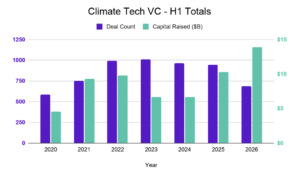
This second chart is the data for the first two quarters of every year since 2020, but only for the climate tech sector within the Venture Capital industry. There are some striking similarities between these two charts – namely that deal count seems to be declining after plateauing over the past few years, and the amount of capital being deployed is also experiencing a massive upswing.
The largest deals in the sector over the past quarter had to do with compute efficiency, nuclear fusion and rare earth magnets – all sectors that are experiencing the tailwinds of nearshoring, geopolitical instability, and of course, artificial intelligence. The prospects of near-term load growth on the electricity grid is forcing operators to think outside the box and encourage new solutions to come into the market, and we’re starting to see the dollars follow. For those of us who are in the business of new technological and market innovations that promote sustainability, this can be a very promising data point. Investment dollars and customer desperation can be leading indicators of these solutions coming to market.
On the flip side, we’re continuing to see a significant decline in the earlier stages of venture, specifically within the cleantech sector. In fact, the earlier the stage, the steeper the decline appears to be. Deals up through and including Series A was reduced by 40%, while only focusing on the Seed stage reduced by a dramatic 46% year-over-year.
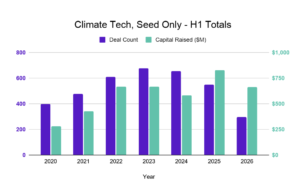
As can be seen above, the purple bars are declining in an accelerating manner. Now, the Seed stage deals of today are the Series A deals of tomorrow. It’ll be very interesting to see how this contraction flows through the rest of the sector over the coming years, and whether there will be any meaningful contraction in the capital being deployed. I generally subscribe to the thought that there is safety in numbers when it comes to making new investments, and this data proves that the median and average deal size is going up.
Lastly, when looking at the trailing 12-month figures for the space, we are also seeing a clear divergence in the slopes of deal count vs capital deployment.
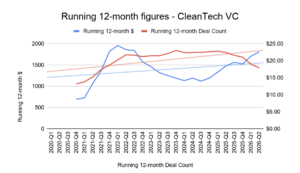
This statistic will be a telling sign on how durable these trends are, and crucially, how they will develop over time as the massive AI capex investments are realized. Now to be clear, fewer deals in the cleantech sector is not necessarily a bad thing. It is perfectly reasonable that the period from 2022 through 2024 was the outlier, with the Inflation Reduction Act and other momentum providing a particularly friendly environment to start a cleantech company. It’s more important for there to be dollars available and willing to be invested into these opportunities for there to be a meaningful benefit in the future. However, there is probably some floor of deal count that we want to stay above to make sure we have a healthy sector.
So how does this all tie back to the previous tremors that scour economic history? It’s no secret that we have an unprecedented amount of capital chasing a new technology, one with a payback period that is uncertain. Even more, the pace of change within this sector is something that we haven’t seen before, where capabilities are matched and surpassed within a matter of weeks, threatening the viability of investments and both mature and newfound businesses. I tend to skew optimistic, and do think that human ingenuity, creativity and curiosity will allow AI to increase the aperture with which we see, understand and experience the world. But there’s no doubt that we are in uncharted territories.
***
As always, all data referenced here is queried from Pitchbook. Please let us know if there is any additional analysis you would like to see in future posts on this subject.
***