

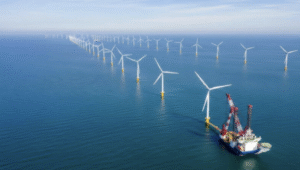
 Credit: TotalEnergies
Total Recall
So in a strange and hilarious situation, the Trump administration agreed to pay TotalEnergies not to not build wind projects, and agree that they wouldn’t pursue wind projects in the United States, and also say publicly that wind power wasn’t in the interests of the United States. Obviously, domestically manufactured energy generation systems with a high capacity factor creating jobs in rural areas = Unamerican.
Total’s announcement included this paragraph (emphasis mine):
TotalEnergies’ studies on these leases have shown that offshore wind developments in the United States, unlike those in Europe, are costly and might have a negative impact on power affordability for U.S. consumers. Since other technologies are available to meet the growing demand for electricity in the United States in a more affordable way, TotalEnergies considers there is no need to allocate capital to this technology in the U.S.
That totally sounds like a sincere statement and not just the Trump administration telling it what it had to say to get the money right? As part of the deal, Total is theoretically going to get hundreds of millions of dollars it paid for wind leases back to the government (although it’s not clear that’s like a legal thing that can actually happen) and build some gas projects instead, which is something they already do a bunch of. I assume company’s analysis is that once a different administration that is friendlier to renewable energy comes into power they’ll be like “LOL sorry no hard feelings let’s build some wind.”
 Cache Energy founder and CEO Arpit Dwivedi, in dark shirt. Cache Energy. Credit: Wall Street Journal
Just Add Water
The Wall Street Journal wrote a nice article highlighting Champaign, Illinois based Cache Energy. Check it out! Cache is iterating on a known process to develop long duration thermal energy storage (which stores heat instead of electricity). Unlike many of the other approaches in this space, their storage medium is able to be stored in ambient conditions, which could make it a particularly good fit for heating loads in harsh and remote environments; thermal storage has the potential to decarbonize major chunks of industrial emissions from process heat (which is usually provided by fossil fuels and can be difficult or cost prohibitive to electrify directly).
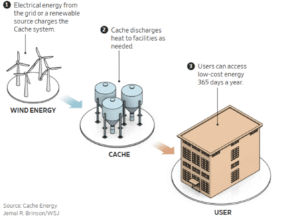
Evergreen was a very early investor in Cache. Fast forward a few years and they have Several pilots and a Fortune 500 company as a customer – Arpit is working hard!
Fun fact – as part of our investment program, we have new applicants send us a quick video of what they are working on. When folks are looking for guidance on this front, the sample video we share with them is Arpit describing Cache energy. He did a great job explaining the problem he’s solving, how his solution addresses it, how it actually works, his point of technical differentiation, the market he is serving, and his next set of milestones, all in a few minutes, without having a bunch of fancy slides. You can check out a clip of that video from here if you’re interested.
Hormuz’in for a Bruisin’
The US is at war with Iran. There are many implications for the economy (energy and otherwise) with the strait of Hormuz closed. Gas prices and fertilizer prices are a couple that are getting a lot of attention given how salient and important they are to the global economy. Here’s an analysis of commodity prices from the Agricultural Risk Policy Center from North Dakota State University that has a lot of good data. One interesting factoid – although only 12% of urea (nitrogen fertilizer) comes through the Strait of Hotmuz, urea prices are up about 30%, which smart people say is a function of the extremely unfortunate timing of this supply disruption just as farmers enter peak fertilizer usage in the Spring (and further exacerbated by a spring planting season that is a few weeks earlier in parts of the country). At least we got through March Madness without a buffalo wing supply disruption…
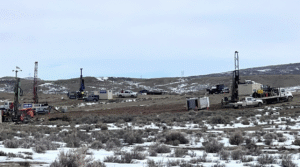 Credit: Terrapower
The Nuclear Option
Advanced nuclear company Terrapower received approval to start building its first reactor in Wyoming. As we noted back in June 2024 when the facility held its construction groundbreaking, this reactor is cooled with sodium instead of water, with a molten salt energy storage system that makes it a better fit for the variability of renewable power on the grid.
 Credit: Lucid Motors
Where did the back seat go?
THe Lucid robotaxi concept, like Tesla’s, is a two-door, two-seater vehicle. This surprised me a bit, since nearly all vehicles sold today have (at least one set of) rear seats, so I went poking around – apparently the smaller two-door cars have significantly fewer parts and are much cheaper to build, and the vast majority of ridehailing trips involve one or two people.
This difference is more pronounced in electric vehicles, because as you make the vehicle profile more aerodynamic, you reduce the drag, which improves the efficiency, which allows you to use a smaller battery pack, which makes the vehicle lighter… in a virtuous cycle that has a real impact on operating costs (since it is assumed that these vehicles are in service most of the time, in contrast to a personal vehicle that is mostly sitting around).
Other News
Finally! SBIR programs were reauthorized, a critical source of funding to help commercialize early stage technologies.
Solar and Wind have grown a bunch, last year they generated 17% of U.S. electricity.
Credit: EIA
Tesla opened its first public semitruck charger facility in California, with max charging rates of nearly a megawatt per hour (hat tip FoT Newsletter).
GE Vernova and IHI tested100% ammonia combustion in an existing gas turbine. Assuming they handle the ammonia slip (which can create potent greenhouse gases), this could provide an interesting pathway to decarbonization at a lower cost than upgrading to systems that can combust hydrogen.
PJM wholesale electricity prices were way up in 2025 (increasing 56% overall).
The Trump Administration offered new Alaskan oil and gas leases in the Cook inlet; no one bid on the leases. I don’t know the exact economics of an offshore oil project, but I do know they are capital intensive and take many years to develop. Presumably the whipsawing between the last couple of administrations on climate policy and the future expectation of additional climate policy lowers the expected value of the project to a point where oil exploration companies don’t want to take the risk.