

The Fusion of Two Unrelated Businesses
Trump Media (ticker DJT) announced it was going to merge with TAE, a fusion technology company that has raised more than a billion dollars in venture funding over the last decade.
DJT is effectively a meme stock, whose stock performance are loosely related to their financials (their CEO made 10 times their revenues in 2024, although in general meme stocks can still be real businesses too – Gamestock owned video game stores when it became a meme stock, and still does). DJT gets an injection of meme-ness in the form of a fusion startup, which could ostensibly address the power demands of the AI boom in the future.
TAE will have line of sight to additional funding ($200M perhaps) that it needs to continue advancing its reactor designs, along with the potential to use the company’s brand meme-ness to raise more capital in the future. And this stuff is expensive! According to Pitchbook the company has previously raised well over a billion dollars from private markets, and a good chunk of that has been at what looks like a flat valuation over the last half decade (although the valuation on their last most recent round is not listed).
And while I don’t offer investment advice, in case you get asked about your favorite stocks, fusion is not like an actual thing yet – it’s an important area of research and development, and a research reactor has created energy for short periods of time, and numerous well funded startup companies are working on this enormous challenge, but this is a technology that is years from operational reactors, and many years away from commercial viability.

Financial and Roof Engineering
The North Carolina Insurance Underwriting Association (NCIUA) recently garnered attention for issuing an innovative Catastrophe Bond (or “Cat Bond”). This instrument helps transfer some of the risk of major weather disasters from insurers to capital market investors – Cat bonds pay attractive rates and most of the time when nothing happens, and then if something really bad happens (the catastrophe occurs) then the investors are on the hook, and are a common financial industry tool.
The innovative wrinkle to this one is that the bond’s interest rate is tied to investments in resilience. Of the $600 million bond, $2 million a year is reserved to help homeowners in North Carolina install stronger roofs that will hold up against hurricanes, and as more of the homes that are connected to this instrument have resiliency measure installed, the interest rate goes down (because the risk has gone down because the expected payout value has gone down, so you don’t need to compensate investors as much). Pretty cool!
(Hat tip to Third Sphere for flagging this news)
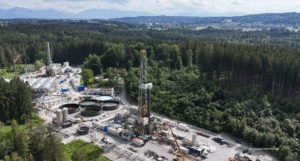 Credit: Eavor Deutchland
Subsurface News
Several good news items from below our feet! First, geothermal exploration company Zanksar announced it found an unknown geothermal resource that is commercially viable, the first find of its type in several decades. Making exploration cheaper and faster is critical to making geothermal more cost competitive, and Zanksar leverages geoscience modeling and AI in their approach to do just that.
Elsewhere on the Earth’s crust, advanced geothermal company Eavor began operations at its first commercial plant in Germany. Eavor is developing closed loop systems with new drilling techniques, which is one of a suite of advanced geothermal approaches that has the potential to enable geothermal power in a much wider variety of geologies and geographies around the world (vs just where there are very hot pockets near the surface, which is how we tap into geothermal today, and the kind of resource that Zanksar found).
And, startup Vema Hydrogen announced a conditional offtake agreement to supply hydrogen that the company intends to extract from the ground after speeding up the natural formation process. This team is trying to call this a new color of hydrogen (orange), but to me it sounds like a flavor of geologic hydrogen (white) that we mentioned last year. As folks are looking for natural geologic hydrogen deposits, there is also research around how to speed up subsurface formation where it is already occurring and reachable with conventional drilling techniques, so I would lump it into that basket. Maybe we can compromise and call this creamsicle hydrogen?
 Credit: Ford
Ford’s Long and Winding EV Journey
Ford took a gigantic writedown and announced it was going to stop producing the all-electric Ford Lightning (which was well very received initially but has had lagging sales and is not profitable for the company, and was never able to hit the sales price point it originally projected). Last year we talked about how large Chinese vehicles were taking a new approach where the vehicle had electric architecture, but also a small gas powered engine to charge the battery for longer ranges; Hyundai announced an SUV like this as well and now Ford is going this pathway, which is called an EREV for “Extended Range Electric Vehicle” by nerds like myself. This technology pathway means you have a lot more parts under the hood, but it both puts to bed any concerns about range anxiety, and also means that you can put a significantly smaller battery in the car (which is both very expensive and very heavy). Most of the media I saw on this announcement framed this as the company walking away from its electric vehicle focus, but I think it is a more nuanced situation where they are adapting to higher than expected production costs, slower than expected sales, and borrowing a successful strategy from other companies. That said, it will have very real impacts, especially on the battery sector, although in Ford’s case they are planning to repurpose some of their assets to build grid storage instead of EVs.
Grid notes:
- PJM just held their capacity auction for 2027 & 2028 and after years of very low bids in the recent past, this auction came in at the maximum allowed by their current rules, $333.44 per megawatt. Even so, this didn’t secure enough power for their targeted 20% reserve margin; next year, the price cap will be gone. (hat tip to Heatmap news on this)
- FERC is pushing PJM to make better rules around colocation – this is good! Right now, if you need 100 megawatts of power and are going to co-locate 90 megawatt worth of generation assets, you need to get approved for a 100 megawatt interconnection, even though you only need 19 megawatts from the grid.
- Also if you’re curious why PJM comes up so much, it’s because it is the nation’s grid operator, and a very broad swath of stakeholders is frustrated with the clunky rules and slow pace of changing them that the grid operator has.
- BNEF expects 36% more power demand from data centers by 2035 than they had estimated earlier this year. This is a signal of how fast the industry is moving, although BNEF’s methodology is tied to supply chain and procurement and has been more conservative than some other estimates in the recent past.
- Grid operators are figuring out how to handle large load interconnection, with dozens of new large load tariffs on the way
.Other News
The Small Business Innovation Research (SBIR) program is an important source of grant funding for deeptech startups, and its reauthorization has unfortunately lapsed. This means that awards out of existing solicitations can still be made, but they can’t issue new solicitations for new R&D program areas. This is an unnecessary headwind, although it is my impression it will be reauthorized in the coming months in some manner.
Pacific Northwest National Lab (PNNL) now has a grid storage pilot testing facility for larger scale demonstration testing.