

 Credit: Bloomberg / Getty Images
Fervo!
Fervo went public in May, a much anticipated milestone for the geothermal company specifically, and for the climate tech sector more generally that has not had a great deal of recent public offerings. The company has done a great deal to innovate and drive down costs, and is coming to market at a time when the ability to deliver new firm power generation is in short supply (of any kind, let alone low carbon power). I’m excited about the future potential of the company, and it serves as a proof point that you really can commercialize innovative new climate tech solutions, although recent weeks also remind us how the story is still being written – unfortunately the company also recently suffered a technical setback at their first commercial facility.
 Credit: Antora
Hot Off the Presses
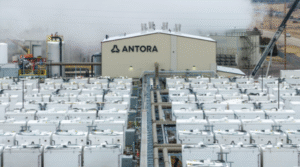
Antora and POET announced the commissioning of Antora’s first commercial project, a 5 gigawatt-hour multi day thermal storage system a POET ethanol plant in South Dakota. Shout out to Evergreen Expert Jack Roback, who has been working hard on this!
Solar As Energy Security
One ripple from the closed Strait of Hormuz – emerging economies are accelerating their energy transition. Pakistan recently set a target for 60% renewable electricity by 2030 and 95% by 2040. This shift reduces emissions and air pollution of course, but is really driven by a push to reduce dependence on imports and improve energy security, while lowering power costs. This echoes the discussion in last month’s Roundup about the Ember report I highlighted, that while the US is generally focused on speed to power for the data center build out and rolling back climate policy, the energy transition is accelerating across the global economy.
Data Center Innovation Initiative
Speaking of data centers, Elemental Impact announced a new initiative supporting new climate tech for data center applications with Microsoft, Google, Amazon and Meta. The initiative will provide investment capital and project development support with an aspiration to pilot and implement new technologies. Interestingly, the initiative is focused on innovations that can apply beyond data centers, so commercial & industrial HVAC innovations are in scope, but cooling for servers themselves is not, so these solutions can potentially utilize the great data center build out to commercialize new innovations that have broader climate impact across industry.
 Credit Craig Lee / The Examiner
Evolving Autonomous Vehicle Landscape
The autonomous vehicle landscape is changing rapidly in multiple ways. In addition to the increasing number of vehicles and cities with programs, how these vehicles are considered and evaluated as it relates to human safety, crash liability, and geopolitics is also evolving. Of note:
- A group of doctors recently began advocating for policymakers to support autonomous vehicles development, given the potential for the technology to save lives and dramatically reduce injuries from accidents.
- Leading Chinese EV manufacturer BYD also announced full liability coverage for its smart driving systems. I have long believed that automakers were going to be on the hook for AV crash liability eventually, but now it is moving to be more explicit with BYD’s announcement – a move we should expect every other automaker to make in the coming year or two (who wants to buy a car with self driving systems from a company that won’t put its money where its mouth is?).
- China has made major inroads into every country’s auto market that it has entered, but as of now, the United States is off limits. Or is it? Waymo just began rolling out the new vehicles from its partnership with Chinese automaker Zeekr. While these are robotaxis, versus a retail brand, they are Chinese vehicles hitting US streets, which means that Americans will be exposed to (at least some of) them and be able to form their own opinions about how they feel about chinese vehicles, which may or may not align with our Federal policy approach.
Other News
The new 16MW largest floating offshore wind turbine was recently installed in China. For reference, the turbines that you see driving south down I-57 and I-65 are a tenth that size.
Rocsys is a company developing a hands free robotic operation to charge robotaxis.
California Resources Corporation began injecting into the state of California’s first operational carbon capture and storage project.
NTT, the Japanese data center operator, agreed to buy carbon removal credits from Climateworks.