

 Credit: Gates Notes
Gates Letter Controversy
Bill Gates ignited some controversy in the climate community with his recent letter where he encouraged climate advocates to prioritize human health outcomes and discussed the tradeoffs that exist between addressing climate change and helping advance human health priorities.
I think of Gates as a human health focused philanthropist first and foremost, in addition to being a major proponent of climate action. So, talking about the tradeoffs between those two priority areas doesn’t seem that odd to me, and obviously in a world with scarce resources, there are points at which these priorities could be in conflict. Specifically, he was calling out how the focus on reducing near term emissions might not actually be the most impactful policy lever, especially for poor countries that struggle with other challenges (like preventable diseases and nutrition).
I also get why many folks had negative reactions to it – if your focus is on addressing climate change, then a message saying “we should prioritize other things sometimes” is unlikely to go over that well, even if plausibly true.
More broadly, I see his communication as attempting to reposition the climate action debate to be inclusive of adaptation and to create a framing that enables continued engagement with ideological policymakers who reject the importance of addressing climate change.
Permitting For All
 Credit: nrdc.org/Jeff Hu/iStock
There’s increased attention once again to permitting reform, with a bill moving out of House committee recently. It is not clear whether it has the legs to actually pass, partially because the agreement would restrict the Trump administration’s ability to withhold federal permits from wind and solar projects that he doesn’t like. One interesting nugget about this issue is how universally desired permitting reform actually is. On the renewables front, Third Way recently released a survey highlighting how significant federal permitting delays were to clean energy projects.
One particular challenge is that there are a bunch of federal agencies, so although they are all part of the federal government, there is not currently one entity that a developer has to deal with. When I saw this issue close up at the Department of Energy, a related issue was that many of these agencies weren’t actually that focused on addressing these delays and burdens. For example, the Fish and Wildlife service was very focused on…. fish and wildlife protection, as you might guess, and less so on ensuring efficient regulatory review for a transmission line.
Meanwhile, the oil and gas industry actually supports both the permitting reform in general, and the clause that would stop the Trump administration to withhold federal permits from renewables projects specifically. They are looking to the future recognize that while this current administration is targeting wind projects, a future administration might target their own oil and gas projects with the same approach.
 Solar panels in India. Credit: Saumya Khandelwal for The New York Times
China’s Energy Transition
China is on track for emissions to be flat in 2025, the first time they would have ever not increased in the last several decades. China is building a huge share of new zero carbon power, across solar, wind, and nuclear, as well as fossil fuel power as well. And, as it has pursued an industrial strategy focused on dominating the supply chain of clean energy technologies, it is now exporting those affordable clean energy technologies around the world. As this New York Times piece highlights, “Chinese industrial policy is shaping the development trajectory of some of the world’s fastest-growing economies.”
Data Center Demand Agita
There’s more drama with PJM, as they are having trouble figuring out a path forward on how to deal with new data center loads that their members can agree on. One approach PJM is considering would require periodic blackouts for data centers and potentially other customers as well; which has led to the independent PJM Market Monitor to push for PJM to not connect new data centers unless they can ensure there won’t be blackouts required, but there is disagreement as to whether that is something PJM actually has the authority to do.
Other News
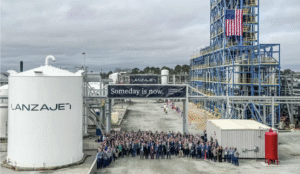 Credit: LanzaJet
Chicago based Lanzajet announced they had begun production of jet fuel from ethanol at their first commercial plant in Georgia – the first company to make jet fuel via this technology pathway. Congrats!
 Credit: Form Energy
Form Energy’s first 100-hour duration long duration energy storage systems (LDES) are being deployed and commissioned. They cite additional demand from the data center power boom, although long term the LDES space will require market rules changes to reach its full potential, as we wrote about earlier this summer.
Portfolio company Lakril was highlighted as one of ten startups to watch by Chemical and Engineering News. Lakril makes biobased acrylic acid (commonly found in diapers, paints, and adhesives) from intermediate products fermented from agricultural crops.
Teleoperations company Vay received a strategic investment from southeast Asian ridehailing company Grab to expand its business. We have mentioned Vay in the past; while I was wrong that they had more short term impact than autonomous vehicles, they have carved out a nice niche for themselves in rental car logistics.