

 Credit: Robert Thiemann via Unsplash
BAAJA Blast?
After years of hand waving about permitting reform, bipartisan bill text was released, The Bipartisan American Affordability and Jobs Act (BAAJA). Third Way’s One BAAJA Blast, Please is amongst the most useful summaries and also has the best title. The Senate is on track to vote on this on November 9. I’m excited about the bill’s potential in general – not being able to build stuff has a significant bias towards incumbents and against innovation, and about the transmission provisions in particular, which is near and dear to my heart from my time helping implement federal transmission development support processes at the DOE.
The big sticking issue is around how the law tries to create project certainty. At the end of the day, this bill’s passage will come down to whether the Trump administration is willing to follow the rules/law or wants to act unilaterally. The project certainty provisions are in there because of Trump administration actions, but there is concern about the unintended consequences of these provisions. I don’t know enough about the particulars of the project certainty provisions to say much about it, although I take it as a good sign that that’s the nitty gritty consideration under debate at this point, and overall it appears like BAAJA would be very positive for having a more functional system.
Some folks are also suggesting Democrats should wait until after the election and negotiate with a stronger hand – I think that is an obviously bad idea. It’s an intentionally bipartisan piece of legislation! It’s not like there are 8-9 votes they could peel off if they took back the Senate Majority and wanted to move a substantively different piece of legislation, so kicking the can would mean you spend time working on this instead of something else next Congress while likely not gaining anything in practical terms.
Carbon Removal, Now in Bond Form
Citi closed a $72 million Carbon Removal-Linked Note to support Applied Carbon’s biochar project in Texas. Instead of traditional coupon payments, investors in the 3.5-year note receive carbon removal credits the project delivers, while the project gets cash up front, with brand name stakeholders like NuVeen and Microsoft involved. This is an interesting new financial approach, and a good example of how, as the carbon dioxide removal (CDR) space grows and matures, it can start tapping different, more traditional, and ultimately lower-cost sources of capital.
 Credit: Constellation
Uprate Expectations
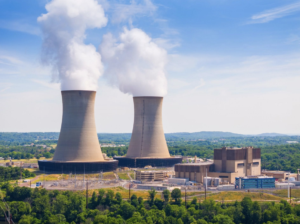
Google signed a deal with Constellation for 890 megawatts (MW) of new power from uprates at 11 reactors across PJM, the grid operator covering 13 states from Illinois to New Jersey. An uprate is an upgrade that lets an existing nuclear plant produce more power. That came a week after Amazon’s deal with Constellation to add 190 MW at the Calvert Cliffs plant in Maryland. The hyperscalers want new power quickly, ideally clean new power, and will find it anywhere they can. DOE is in on the act too, offering Vistra a $4 billion loan for uprates in Ohio and Pennsylvania.
It wasn’t actually that long ago that these nuclear plants were getting shut down because they weren’t economic – in the last decade. Oh, how times have changed, now people are paying for them to expand!
 Credit: Antora Energy
Antora Turns Up the Heat
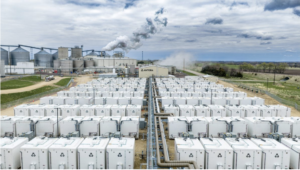
Thermal energy storage company Antora Energy announced a 5.8 gigawatt-hour (GWh) thermal battery at Pratt Energy’s ethanol biorefinery in Pratt, Kansas, under a long-term offtake agreement. Antora’s thermal batteries store cheap electricity as heat in blocks of carbon and release it on demand as industrial heat. This is the company’s second facility, after a 50 MW / 5 GWh system in South Dakota that it commissioned in May. Industrial and process hear is an enormous business and climate opportunity that doesn’t get as many headlines as grid drama.
Other News
 Credit: EIA
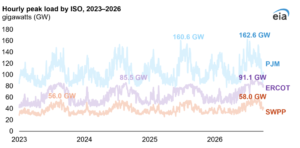
PJM, ERCOT, and the Southwest Power Pool all set all-time peak load records this summer, with PJM hitting 162.6 GW on July 2. Four other grid operators, including MISO, came within 4% of their records.
Google and Voltus expanded their “bring your own capacity” (BYOC) deal tenfold, from 100 MW in June to a 1 GW virtual power plant (VPP) in PJM.
Ford’s upcoming affordable electric pickup, the Fathom, has bidirectional charging capability, and won’t need a separate wall mounted inverter, cutting down on install and equipment costs.
The PJM saga continues. Some good (the ability to expand VPPs using new batteries at existing sites), some not so good (FERC rejected PJM’s data center curtailment plan and its BYOC rules, and PJM has scheduled its backstop auction to March 2027).
Investments in AI infrastructure are driving new storage tech investments, according to Pitchbook.
NETpower, who I have highlighted in the roundup over the years, has pivoted from a novel low carbon power plant architecture that captures CO2 as part of its process to just building natural gas plants for new data center loads. In the words of Harvey Dent in the Dark Knight, “You either die a hero, or you live long enough to see yourself become the villain.”
