

We have an admission to make at Evergreen. We are repeat battery investors. Who can blame us for an investment opportunity that carries significant technical risk, massive amounts of scaling required to be economical, and at the end of day be rewarded with single-digit margins? Of course, the sheer size of the market, and the impact it can have on electrification throughout a myriad of industrial activities make these investments worth making. However, merely looking at the battery industry of today misses a lot of key points.
It’s no secret that batteries are a critical technology, and their supply chains are being seen more and more as a matter of national security. Indeed, while there might be a short-term pullback on EV demand in the US, there are still countless products that are getting electrified, or having their capabilities increased through further electrification (I’ll raise you your electric toothbrush with an AI-enabled electric toothbrush). All this means that the global capacity of battery storage and needs will continue to grow. Given that there are large tailwinds towards electrification of a number of technological products, both from the mundane to critical military applications, it makes sense that countries would want to be able to have their own secure supply of domestically produced batteries to serve all of these critical purposes.
However, what is undeniable is the massive technical, manufacturing and supply-side advantages that China holds for batteries. It’s an impossible elephant in the room to ignore when assessing any potential battery investment that comes to Evergreen. If battery producers wanted to create a worldwide cartel for this critical commodity, similar to what OPEC is for the oil industry, it would be a one-party cartel. And it’s not unreasonable to think that China has produced an insurmountable lead in this current generation of battery technology. We see battery technologies all the time come through our investment pipeline, and we always strive to assess these solutions not in terms of where the price of lithium ion batteries are today, but where they will be in 10-15 years (hint: prices have largely been on a one-way street).
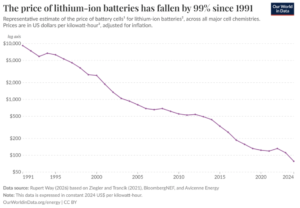
In order for America to gain a competitive advantage, we really need to look at technologies not in this generation, but in the next generation. Much like how underdeveloped regions are adopting modern solutions for areas such as banking, electricity grids, and personal computing by skipping their predecessors, America might need to pull off a similar type of technological leapfrog to remain competitive with China in batteries.
So what does a generational leap look like in the world of batteries? Enter the air battery. While the concept of a metal-air battery has been around for decades, it’s not something that has been able to achieve any commercial traction for many purposes. The primary downside to previous attempts has been longevity over multiple cycles, as ambient air is inconsistent and dramatically reduces the efficient life cycle of these cells when compared to standard lithium-ion batteries. However, the upside of solving these technical problems is an energy-storage solution that is truly off the charts. Being able to effectively pull the cathode reagent from the ambient air “for free” can dramatically reduce the required mass for a given energy level. And our bet on who is the best shot we have to accomplish this lofty goal? Air Energy.
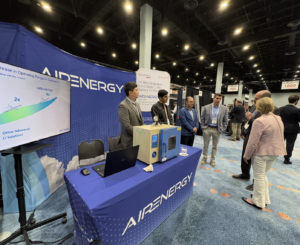
Whereas the most state-of-the-art lithium-ion batteries could achieve a gravimetric density of 300-350 Wh per kg, Air Energy’s cell technology has proven to be able achieve an astronomical 1,920 Wh per kg. That’s nearly a 500% improvement! Such a step change in capability truly opens the aperture for both energy storage and electrification applications. What is Air Energy’s secret sauce? It comes down to a few key innovations that unlocks this vast storage potential. First, Air Energy’s proprietary solid-stage electrolyte enables a four-electron reaction while keeping operations safe and reliable. There is also a custom catalyst that has demonstrated durability over many cycles, and could be the fundamental building block that allows this iteration of an air battery to succeed where those before it had failed.
The potential for this technology really is gamechanging, and could really spur forward the adaption of electrification in more and more products. And being experienced battery investors, we know that the road ahead will likely be long, arduous, capital-intensive and a little bit unpredictable. However, investments in these cutting-edge technologies that have world-shaping potential is exactly the type of investment we at Evergreen specialize in. It’s a short-term perspective to think the negative sentiment surrounding EVs and electrification today has any durability, particularly when it would require ceding this key technological area to our great modern-day rival. Air Energy gives us the opportunity to stake our claim to winning the next next thing in the world of batteries, and in our mind, is an essential investment to make to maintain a balance against China’s dominance in this critical sector.