

PJM IRAS BYONC
It’s official, PJM finally has a plan to deal with the onslaught of new data centers vying for power. It is a bit of a grid acronym word salad: the IRAS (Interim Resource Adequacy Service) approach requires new data centers (large loads over 50 MW) to BYONC (bring your own new capacity). If they don’t, then they’d be on the chopping block to have their service curtailed during peak periods, but really need state policymaker support in helping ensure that is a reality.
As the former Treasury Secretary Timothy Geithner liked to say during the financial crisis, “plan beats no plan.” This one has the benefit of being an actual plan, and doesn’t seem like an insane approach to me. And there are some significant upsides – principally, under the BYONC requirement, folks can procure new or upgraded power assets, battery projects, and importantly, demand response aggregation and VPPs – so the door is open for load flexibility to be a major part of the solution. And I think it will end up being a big part of the solution, partially because while these issues have unfolded on the load management side, PJM hasn’t really addressed the interconnection bottlenecks that slow down new generation assets from getting connected (whereas flexible capacity can be brought into service much more quickly, since the assets already exist).
This doesn’t actually solve PJM’s long term capacity market challenges, either – excluding data centers from capacity markets, as they propose to do later this decade, reduces immediate capacity market pressures and addresses the current crisis, but could further erode the market mechanism over time, because if a developer is choosing between bidding into a market and signing a long term offtake with a hyperscaler, the long term offtake is likely to be preferred (because it is stable and easier to underwrite).
I predict this will be a wild and wooly year for state level activity for states in PJM, as policymakers, regulators, and and utilities work to ensure they have the frameworks in place to ensure their states can align with (and benefit from) this new approach (such as large load tariffs and policies to potentially incent certain types of generation or virtual power plant programs in a particular state).
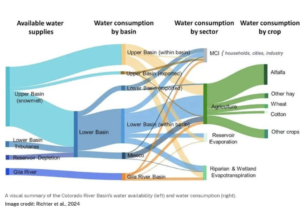
Western Water Crisis?
The Trump administration has moved to impose cuts in water for the lower basin states of the Colorado river (California, Arizona and Nevada) amidst the current water crisis that is threatening the operation of dams along the river (the big basins are at their lowest ever levels). This is a reasonable approach to do something, although longer term a broader based approach is warranted.
Importantly, as Matt Yglasias has noted and discussed extremely articulately, the actual issue is not that we are running out of water, we just have a crazy set of incentives in place that encourages existing water rights owners to act in a way that maximizes their own self interest but not the overall sustainability of the watershed (by growing water-intensive alfalfa, for example). The fantastic water accounting sankey diagram above is from a Nature article by Brian Richter et al. via Matt’s Slow Boring, demonstrating that more of this water is used for growing alfalfa than for people and industrial uses.
Batteries!
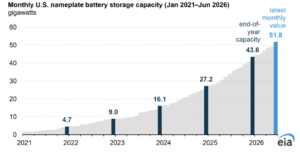
Battery storage capacity grew an average of 70% a year the last 3 years, per EIA
That’s some explosive growth that can be attributed to a mix of declining cost (good), policy changes (good) and additional concerns about managing peak capacity (good, for batteries at least). The growth rate is coming down (as one would expect as you add scale) but actual deployment is skyrocketing – more battery capacity was added to the system last year than existed at the end of 2023 total in the US.
As it has grown, its primary use has also shifted from ancillary services to more active participation in the energy market (in the form of peak shifting / peak shaving). Speaking of primary uses, the growth of grid scale battery storage has also softened the blog of changes in electric vehicle policy support.
Waymo’ Chinese Vehicles in the US
 Credit: Los Angeles Times via Getty Images
Now that the new (electric) Waymo Ojai vehicles are showing up on the streets, I have seen a few different articles noting how they have managed to introduce Chinese EVs to the US market despite other barriers (as we noted previously) – the vehicles are made in china, then Waymo does their autonomous technology installation here in the US. The first, not the last! While I don’t think their chinese production will be the single thing that helps tip autonomous vehicles into the mainstream, I think it will be an accelerant, as they are able to manage capital costs while providing a high tech experience.
Speaking of Waymo, they received approval to operate essentially anywhere in the Bay Area (including wine country, which is great news for both imbibers as well as people who don’t like car crashes).
Carbon Removal
After Microsoft accidentally caused a bunch of headlines by pausing new purchases of carbon removal, they have announced a new deal with Crew Carbon for an alkalinity enhancement approach, integrated into wastewater treatment processes. We are big fans here of alkalinity enhancement approaches (which portfolio company Aquarry also utilizes, but in pit lakes instead of wastewater streams) – the process utilizes significantly less process energy than many conversion approaches like direct air capture.
This is newsworthy since Microsoft is the single biggest buyer in the market for carbon removal right now. Over time, that is likely to shift to be auctions in Europe for their Emissions Trading System; on that note, this op ed from the Carbon Business Council argues that process should be opened to additional technology pathways. I agree, especially since some of the additional pathways have the potential to be among the lowest cost, although I also get why they started as they did, sticking to a couple of the most mature pathways.
Data Center Opposition
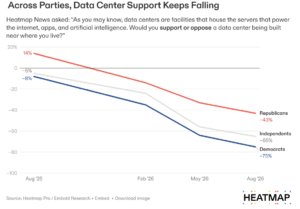
Heatmap polling shows that Americans decided this year they REALLY do not like data centers, creating challenging politics for leaders trying to balance electricity prices and public outrage with economic development (and the potential to benefit from grid infrastructure investments).
Locally, Chicago Mayor Brandon Johnson is proposing a data center moratorium for Chicago (on the heels of other states’ similar action we discussed last month), although there isn’t actually that much data center development activity in Chicago proper to begin with right now.
Other News
Form Energy’s down round (despite a large a growing order book) speaks to general tighness in the later stage venture capital space.
California, Washington state, and Quebec are teaming up on a carbon market.
Another vertical farming indoor ag company shut down – 80 Acres Farms in this case.
Polysilicon tariffs are increasing prices for panels, while increasing incentives for domestic solar production.
BYD installed 10,000 of their 1,500kw chargers in 5 months (from Reilly Brenan’s FOT newsletter which I highly recommend)
Warm ocean temperatures caused a swarm of jellyfish to knock out 2 gigawatts of French nuclear power during a recent heat wave