

PJM Showdown
It might be summer but it’s not slow at PJM. Its summer auction triggered price caps and didn’t secure enough capacity for 2028 (there is a tension between affordability and providing a market signal to build). And, after the grid operator has been (slowly) contemplating its next steps to deal with its current crisis, FERC indicated that it would step in and impose changes this fall if the PJM didn’t act and the White House is holding stakeholder meetings on the subject.
The technical term for this is a mess. As my corporate governance professor Dennis Chookazian liked to quip, “nothing changes until something bad happens.”
What is going to happen? Something! As I suggested last September:
These problems have been a long time coming, but now that they are highly salient because of electricity price increases there is dramatically increased attention from policymakers (even if many of the near term price increases have more to do with distribution system investments, there is also increased consumer awareness of the AI/data center boom). And this increased attention and salience will lead to action. It was a sleepy issue, now it’s a political issue, which doesn’t mean it will be solved optimally, but it will definitely be focused on and addressed in some way.
What will that something be?
Well, PJM has just announced some big moves:
- New large load category (above 50 MW) that requires that companies either bring their own generation or potentially shut off during grid stress periods starting in 2027
- A bilateral matchmaking mechanism to match new generation with new large loads
- A subsequent capacity auction shortfall
This should presumably help deal with the current crisis, but doesn’t address long term market challenges – and may exacerbate some of them, because by putting together a separate bilateral mechanism to match generators and new loads, it likely disincentivizes generators from participating in the capacity auction (since having a long term offtake contract provides more certainty)
Assuming it is implemented as proposed, these requirements should be a boost for a variety of behind the meter solutions, including long duration storage and virtual power plants.
Longer term, there will likely be some governance changes to increase the board’s independence and give State governments a more formal role (right now, because of the way voting is structured, the operator can have a minority of stakeholders oppose a proposal and end up just not doing anything).
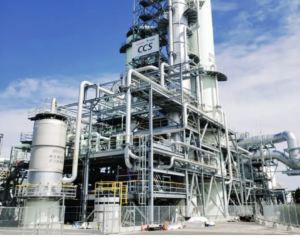 A Toshiba Energy Systems& Solutions BECCS plant (photo credit Toshiba ESS)
Carbon Removal Demand Driver
The EU Emissions Trading System (ETS) recently issues new plans for how and whether to incorporate durable carbon removal into their emissions trading system, which did not previously have a pathway. Going forward, carbon removals can be incorporated into the ETS via an auction mechanism, as opposed to letting the companies procure them directly, to help ensure standards. Currently this plan is limited to two technology pathways: direct air capture (DAC) and bioenergy with carbon capture and storage (BECCS) – the two most mature pathways. CDR.FYI has a useful explainer for those interested in more detail.
I would categorize this as positive progress, even as it leaves out many of the solutions that are extremely promising (but are also admittedly earlier and have less of a MRV track record) – this plan creates a pathway for other approaches to be included in the future.
This should be a significant tailwind for carbon removal more broadly, as one of the big challenges is identifying a large enough universe of customers for the solutions (beyond tech companies); access to the largest carbon credit market directly addresses this issue.
Data Center Moratoria
The New York state one-year data center permitting moratorium we mentioned last month was signed and went into effect. Per Heatmap, the state will spend that time “finalizing a program to make sure data centers either build their own power generation or pay a higher rate for electricity.” More recently, Texas’ Governor also put a de facto moratorium in place in order to conduct an audit of proposals (ie buy some time to figure out what to do). Heatmap also separately reported on the now several hundred local ordinances that ban data centers, the overwhelming majority of which passed this year.
These Governors represent states with very different politics, and come from different parties, but they ended up in more or less the same place. Importantly, they are also both up for re-election this fall from a public that has intensely soured on data center development.
Meanwhile, Michigan Governor Gretchen Whitmer is taking a different approach, advocating for a package of 10 specific commitments for data center developers, but not pushing for a moratorium (she is also not up for re-election in the fall).
States: laboratories of democracy!
Other News
Sunrun is rolling out a new grid edge computing for AI initiative. On a data center development priority list, I would put neighbor’s garage above satellite in space, but below industrial site.

Evergreen portfolio company Intellihot was acquired by Milwaukee-based Zurn Elkay! Intellihot manufactures high efficiency tankless hot water heaters. Congratulations to the Intellihot team!
The Nuclear Regulatory Commission is proposing changing its “As Low As Reasonably Achievable” (ALARA) standard for radiation exposure, to a specific exposure limit. From my perspective, this is a good thing – the ALARA approach was well intentioned policy that had the unintended consequence of driving up nuclear plant construction costs dramatically.
Just when Elon has merged his business interests (from Twitter, X AI, SpaceX, and Tesla down to just SpaceX and Tesla, (and is considering combining the last two big ones), he pops up with a new thing: a personal acquisition of a mobile turbine company. Elon corporate governance: never boring.
I thought this was an interesting op ed, that argued that we need a vibrant domestic EV industry to support domestic battery supply chains for military uses, because defense is too small a market on its own to support a robust domestic supply chain.
The data center boom is putting pressure on electrician training programs
The three-row Tesla Y L is coming to the United States. Originally this EV was just released in China, but this now fills a gap in the Tesla lineup domestically now that the company has ended production of the Model X in lieu of making… humanoid robots, as we highlighted earlier this year (it’s also much less expensive than the Model X).
A post from Crux CEO Alfred Johnson highlighting the domestic solar manufacturing investment spree.