

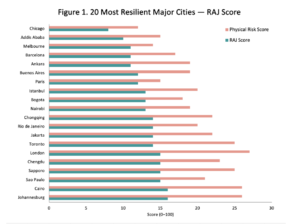
 Credit: Alpha Geo
The Second City is First in Climate Resilience
An analysis from climate risk intelligence platform Alpha Geo ranked Chicago as the most climate resilient city in the world, owing to both its natural advantages (not too hot, no hurricanes, no sea level rise risk) and resilience investments it has made over the last few decades (such as the deep tunnel project). Here’s a Block Club article that quotes friend of Evergreen Karen Weigert extensively, noting that this award is ranking Chicago’s climate future as less bad than others, not necessarily good.
On that note, if August felt hot, it was tied for the hottest month of all time, or, put another way, one of the coolest summer months of the rest of your life!
ComEd Queue Culling
ComEd has been forward leaning in managing its large interconnection queue, asking for a letter of credit to cover the expected revenues a new site would pay in electricity costs, to cull speculative projects, plus asking for its own “connect and manage” authority from ICC.
Their new large load forecast dropped from 39 to 25 GW now as a result. This is a major haircut, although for context, ComEd peak load is 24 GW, so it still reflects a massive buildout..
I think this strikes a balance between cooling things off without becoming a BANANA (Build Absolutely Nothing Anywhere Near Anyone). Data center folks seem willing to accept some interim conditions to be able to stay on the long term track to uninterruptible service.
 Credit: U.S. Department of Energy
Exploratory Funding
DOE is providing important funding to support exploratory drilling and field tests for new geothermal projects. The award list is a who’s who of advanced geothermal companies and power producers, including Chicago’s Invenergy (shout out to Evergreen Expert Jon Horek, who led the Invenergy submission)
This grant support is critical – drilling a test well is expensive and the costs are incurred before you know whether you have a productive asset, making it very economically risky.
It is an exciting time in geothermal, with Fervo going public, new enhanced geothermal companies developing new approaches, incumbent oilfield services companies (who know how to drill) getting interested, and improved technology being developed (like Hephae Energy Technology developing better sensors and tools for high temperature environments, who just raised $17M this summer).
Permitting Reform?
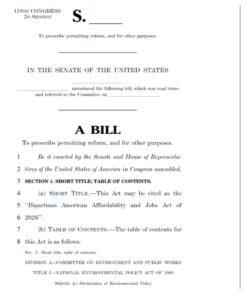
Permitting reform is currently in the category of close but no cigar, yet – the Senate announced it has the deal language for the Bipartisan American Affordability and Jobs Act of 2026, and it hasn’t been voted on (by either chamber). And importantly, one of the main hang ups has been the Trump administration’s intransigence at being required to follow rules and not just randomly block solar and wind projects, and that has not yet been fully resolved. This effort has been a long time coming, and there’s still opportunity for it to fall apart, but here’s hoping there is progress in the lame duck session of Congress (after the election, when it is generally easier to pass compromise legislation).
 Credit: Stardust Solutions
Geoengineering Geoeconomics
Geoengineering company Stardust shared that it could cool the earth by about a half a degree celsius for $10 billion a year via stratospheric aerosol injection of its particular recipe of stuff (here’s a deep dive on this approach).
Last year, we discussed Stardust and geoengineering more broadly, and how you could make a dent in things for a billion dollars or so. And 0.5 degrees is more than a dent, that’s a major move (humans have increased global temperatures by ~1.3 degrees C overall). Importantly, that cost projection is cheap enough that a government could unilaterally start to try to implement it.
This is a space that freaks a lot people out and is still very nascent, but I think is much closer to reality than people may realize – easily something that could happen in a big way in the next 20 years. As such, I think it is incredibly important that researchers continue to explore this space to better understand it (whether or not they think it is a good idea to actually utilize).
Electric Vehicle Resilience?
Electric vehicle sales haven’t yet recovered from the cuts to federal incentives (and the natural pull-forward in demand that that policy change triggered), but with continued high gas prices from the Iran conflict, that may only be a matter of time. In the short run, consumers are not that responsive to oil prices, but they are over the long run, and this may align well with the new crop of vehicles coming to market that better align with American consumer preferences like the Ford Fathom electric pickup that will go on sale next year for 30K, or the Rivian R2.
Or, for that matter, for new EREVs (Extended Range Electric Vehicles). Hyundai announced its upcoming Sante Fe will be an EREV with 600 miles of range. We previously highlighted Hyundai’s move in the EREV direction back in 2024, although now this vehicle is arriving in 2027, not 2026. I’m guessing these will be extremely popular here in the US.
Solar Repowering
This analysis from Foundry Logic makes the case for repowering a bunch of solar assets now that they are reaching their original useful life and their output is declining (it should be noted that this is also the business Foundry Logic is in).
This is an emerging opportunity space, both for solar and wind – right now, my understanding is it generally makes more sense to keep getting what you can out of existing panels, since they’re essentially paid off, although there will be a time where their productivity drops enough that new investments make sense. Since siting and permitting and interconnection have already be completed, there are scenarios where sites could add batteries or edge compute to avoid needing to go through new interconnection processes. This reminds me of the saying that McDonald’s is a real estate company that sells hamburgers – over time, the renewables asset owners may be thought of as interconnection agreement companies that sell electricity.
Other News
On September 9, a virtual power plant managed by Sunrun and Tesla dispatched 580 MW of peak power to California’s grid, leveraging 140,000 batteries, making it the largest VPP dispatch event to date. While just one day, it’s a good proof point and sign of the emerging scale of these solutions – for reference, that VPP is a bit over 1% of California’s peak load.